Euclid telescope's first big data release covers 9,500 full moons
The European Space Agency and the Euclid Consortium have released the first major batch of data from the Euclid space telescope, including 900 million galaxies. It covers an area of sky equal to 9,500 full moons.
- The DR1 Foundation release holds about 13 months of Euclid observations.
- It covers an area of sky equal to 9,500 full moons.
- Analysis found around 15,000 strong gravitational lensing candidates.
- Over 2,500 researchers use the data.
The European Space Agency (ESA) and the Euclid Consortium have released the first major batch of data from the Euclid space telescope. Phys.org reports that it captures light from more than a billion objects, and it is the first major data release since Euclid launched in mid-2023.
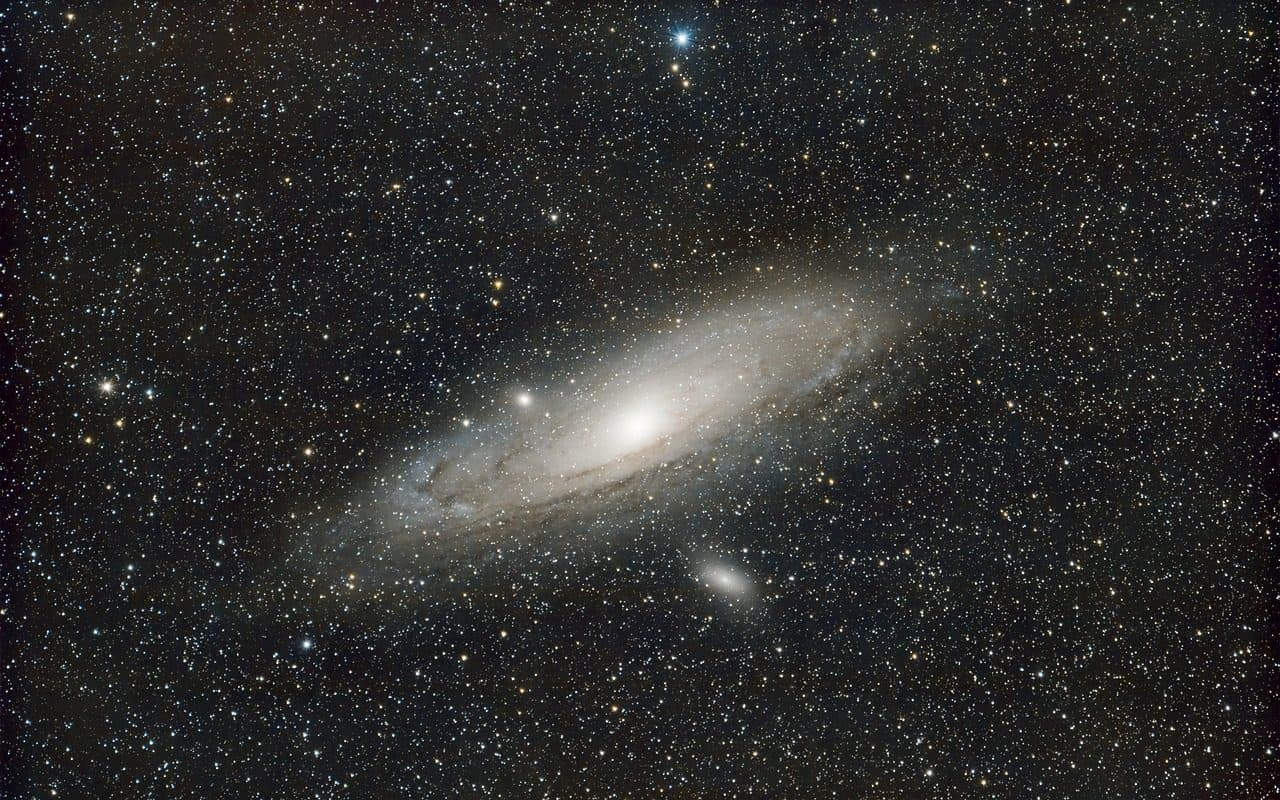
The release, called DR1 Foundation, contains about 13 months of observations and covers an area of sky equal to 9,500 full moons. New Scientist reports that the collection includes 900 million galaxies. Its mosaic of 740 images was collected in autumn 2024 and spring 2025 and covers 367 square degrees of the northern sky. At full resolution the snapshot is 500 gigapixels.
Analysis of about 10,000 science images from the release found around 15,000 strong gravitational lensing candidates. The release also includes more than 60 million quasar candidates and spectra from more than 160 million sources. The Euclid Wide Survey results cover 1,900 square degrees, about 14% of the sky area planned for the six-year mission.
Euclid is on a six-year mission to map about one-third of the sky in 3D. The release includes close-ups of galaxies. NGC 1291, about 33 million light years away, is still forming stars, and Abell 3128, a cluster of hundreds of galaxies about 800 million light years away, contains a strong gravitational lens. Messier 81, a spiral galaxy about 12 million light years from Earth, is the largest in the M81 group, which also includes the smaller NGC 3077.
Carole Mundell, ESA director of science, said: "These are far more than beautiful pictures; today marks a scientific milestone in our study of the cosmos,". Valeria Pettorino, Euclid project scientist at ESA, said: "This is a change in scale from Euclid's previous releases, which included a few days of observations over around 60 deg² of sky,".
Jochen Weller of LMU said: "I am delighted and excited that we can now take another step toward understanding why the expansion of the universe is accelerating—a mystery that has challenged physics for nearly 30 years,".
Several German institutions play key roles. The Max Planck Institute for Astronomy in Heidelberg and the Max Planck Institute for Extraterrestrial Physics in Garching contributed critical optical components. The German Science Data Center, operated by MPE, is processing the data, and more than 300 research institutions analyse it. Phys.org reports that processing is a challenge for computing centres, made harder by tight availability of new hardware.
Background
khabr.pk reported on 27 October that SUPARCO opened a five-day international conference in Islamabad on using space technology for early warning and climate action. khabr.pk also reported on 8 November that a Pakistani astronaut will join China's Shenzhou-24 mission.
Why it matters for Pakistan
The release is a major science data set that readers in Pakistan can follow as part of the wider story of space research. Pakistan has recently been active in the field, hosting a UN-backed space technology conference in Islamabad with about 250 participants from 20 countries. The Euclid data is being used by more than 2,500 researchers, and its results will feed the study of why the universe's expansion is accelerating.
Get khabr.pk news on Facebook and YouTube
Short news videos every day, and the day’s top stories in your feed.